Visualizing Network Data with Kumu#

You’ll learn about visualizing and analyzing relationships and networks using Kumu, covering:
- Understanding Kumu: What Kumu is and its primary function as a tool to visualize complex relationships within data. You’ll learn that it’s applicable beyond social analysis to any scenario involving relationships between entities.
- Social Network Analysis: How Kumu facilitates social network analysis, helping to understand how different people and communities are connected, and identifying common interests.
- Data Preparation for Kumu: The process of preparing raw data, specifically IMDb actor data for Indian movies, to be uploaded to Kumu. This includes filtering for only movies and Indian movies.
- Creating Actor Networks: How to construct an actor collaboration matrix where each element denotes the number of movies two actors have acted in together. This involves a method using matrix multiplication of a movie-actor matrix with its transpose.
- Optimizing Sparse Matrices: Understanding that actor collaboration matrices are often sparse (contain many zero entries) and how to make computations fast and memory-efficient using the compressed sparse row (CSR) format from the
scipylibrary in Python. - Preparing Data for Kumu Upload: How to convert the processed matrix data into the “from node to node” format, along with the strength of the connection (number of shared movies), which is required for Kumu.
- Filtering Data Effectively:
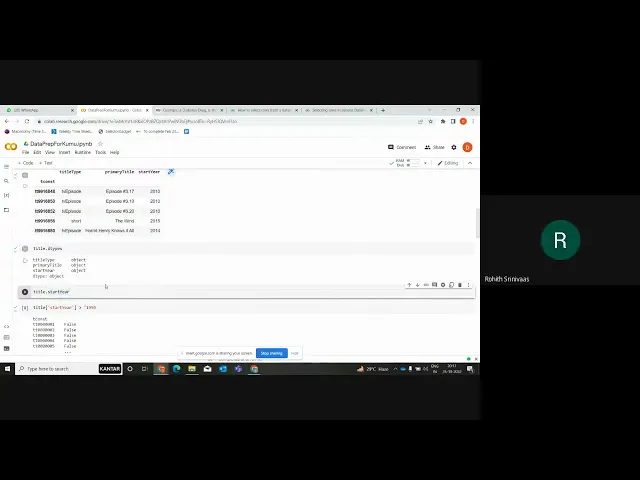
- Filtering by Year: How to filter movie data by release year (e.g., movies released after 1950) by converting the ‘start year’ column to an integer data type, and troubleshooting common issues like newline characters (
/n) within string data. - Filtering by Language/Region: How to filter for specific regions or languages, such as Indian movies, by applying language options within data processing functions or by filtering a dedicated region data frame.
- Filtering Actor Pairs: How to reduce the data size by filtering for actors who have acted in a minimum number of movies and for actor pairs who have acted together in a minimum number of movies.
- Filtering by Year: How to filter movie data by release year (e.g., movies released after 1950) by converting the ‘start year’ column to an integer data type, and troubleshooting common issues like newline characters (
- Visualizing and Analyzing Networks in Kumu: How the prepared data creates a network of actors in Kumu, allowing you to observe clusters and understand direct and indirect connections.
- Exploring Network Connections: How to search for specific actors (e.g., Mohanlal) and examine their direct connections (e.g., Mohanlal and Saikumar acted in 8 movies) and indirect connections within the network.
- Introduction to Community Detection: A brief mention of community detection as a method to identify groups within the network and understand their interconnections, to be explored in other tutorials.
- General Data Science Practices: The importance of using resources like Google and documentation for problem-solving, even for seemingly simple tasks, and the necessity of ensuring correct data types for operations.