LLM Text Extraction#
JSON is one of the most widely used formats in the world for applications to exchange data.
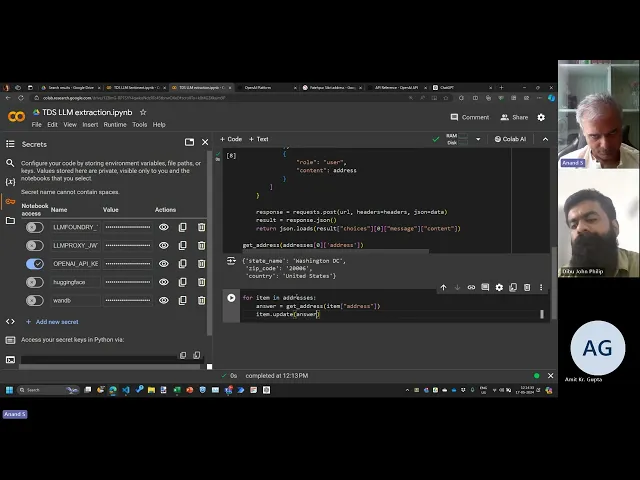
This video explains how to use LLMs to extract structure from unstructured data, covering:
- LLM for Data Extraction: Use OpenAI’s API to extract structured information from unstructured data like addresses.
- JSON Schema: Define a JSON schema to ensure consistent and structured output from the LLM.
- Prompt Engineering: Craft effective prompts to guide the LLM’s response and improve accuracy.
- Data Cleaning: Use string functions and OpenAI’s API to clean and standardize data.
- Data Analysis: Analyze extracted data using Pandas to gain insights.
- LLM Limitations: Understand the limitations of LLMs, including potential errors and inconsistencies in output.
- Production Use Cases: Explore real-world applications of LLMs for data extraction, such as customer service email analysis.
Here are the links used in the video:
Structured Outputs is a feature that ensures the model will always generate responses that adhere to your supplied JSON Schema, so you don’t need to worry about the model omitting a required key, or hallucinating an invalid enum value.
curl https://api.openai.com/v1/chat/completions \
-H "Authorization: Bearer $OPENAI_API_KEY" \
-H "Content-Type: application/json" \
-d '{
  "model": "gpt-4o-2024-08-06",
  "messages": [
    { "role": "system", "content": "You are a helpful math tutor. Guide the user through the solution step by step." },
    { "role": "user", "content": "how can I solve 8x + 7 = -23" }
  ],
  "response_format": {
    "type": "json_schema",
    "json_schema": {
      "name": "math_response",
      "strict": true
      "schema": {
        "type": "object",
        "properties": {
          "steps": {
            "type": "array",
            "items": {
              "type": "object",
              "properties": { "explanation": { "type": "string" }, "output": { "type": "string" } },
              "required": ["explanation", "output"],
              "additionalProperties": false
            }
          },
          "final_answer": { "type": "string" }
        },
        "required": ["steps", "final_answer"],
        "additionalProperties": false
      }
    }
  }
}'
Here’s what the response_format tells OpenAI. The items marked ⚠️ are OpenAI specific requirements for the JSON schema.
"type": "json_schema": We want you to generate a JSON response that follows this schema."json_schema":: We’re going to give you a schema."name": "math_response": The schema is calledmath_response. (We can call it anything.)"strict": true: Follow the schema exactly."schema":: Now, here’s the actual JSON schema."type": "object": Return an object. ⚠️ The root object must be an object."properties":: The object has these properties:"steps":: There’s astepsproperty."type": "array": It’s an array."items":: Each item in the array…"type": "object": … is an object."properties":: The object has these properties:"explanation":: There’s anexplanationproperty."type": "string": … which is a string.
"output":: There’s anoutputproperty."type": "string": … which is a string, too.
"required": ["explanation", "output"]: ⚠️ You must add"required": [...]and include all fields int he object."additionalProperties": false: ⚠️ OpenAI requires every object to have"additionalProperties": false.
"final_answer":: There’s afinal_answerproperty."type": "string": … which is a string.
"required": ["steps", "final_answer"]: ⚠️ You must add"required": [...]and include all fields in the object."additionalProperties": false: ⚠️ OpenAI requires every object to have"additionalProperties": false.