AI Coding Tests#
Testing AI-generated code is about establishing fast, trustworthy feedback loops before the code lands in main. The goal is not perfect certainty—it is a reliable signal that the patch does what it should, fails when it must, and keeps shipping velocity high.
In this module, you’ll learn:
- Scorecard-driven evaluation loops: Track AI agent success with automated suites and selectors
- Premortem test-first flows: Lock in failing tests before asking an agent to code
- Python-first fuzzing and mutation: Catch almost-right code with Hypothesis and mutmut
- Agent-powered smoke tests: Let Playwright bots guard critical user journeys
Build evaluation loops#
Benchmarks stop vibe-coded fixes from quietly regressing. Start with a thin scorecard that runs on every candidate patch, then expand.
Curate a regression suite: Keep a lightweight folder such as
tests/scorecards/that encodes the acceptance criteria for each automation task. Track pass rate over time and graph it. OpenAI evals and Anthropic evals are reference architectures for scorecard runners.Automate the selector harness: When using Mixture-of-Agents or multiple drafts, promote the version that clears the scorecard. A simple shell script works:
uv run pytest tests/scorecards -q --maxfail=1
jq -s '{winner: max_by(.score)}' variations/*/result.json
Keep evaluation in-the-loop: Wire the scorecard into CI so every agent commit runs
uv run pytest(for code) plus any task-specific checks (uvx mypy,npm test, etc.) before merge. Reject green builds unless the evaluation job also passes.
Premortem tests first#
Write the tests you want to see fail before you let the model touch the repo.
- Describe the desired behavior in a docstring or issue comment.
- Ask the agent (or write manually) for precise unit/property tests that encode that behavior.
- Run the tests and verify they fail.
- Only then let the agent implement code until the suite is green.
# tests/test_csv_loader.py
"""CSV loader must ignore BOMs and normalise header case."""

from pathlib import Path

import pytest

TEST_DATA = Path("tests/fixtures/csv/bom_users.csv")


def test_reads_bom_file(tmp_path: Path) -> None:
    rows = load_users(TEST_DATA)
    assert rows[0]["email"] == "[email protected]"


def test_rejects_missing_email(tmp_path: Path) -> None:
    with pytest.raises(ValueError):
        load_users(TEST_DATA.with_suffix(".bad"))
Premortem TDD makes the happy path obvious and stops the agent from rewriting tests to match its output. Treat these red tests as the contract; the agent must satisfy them without edits unless you explicitly amend requirements.
Property-based fuzzing for AI patches#
AI-produced code often fails on weird but realistic inputs. Property-based tests generate thousands of them for you.
- Lean on Hypothesis for Python: Install once (
uv add hypothesis) and import strategies to generate realistic data. The Hypothesis quickstart illustrates the core API. - Codify invariants: Instead of hard-coding outputs, assert algebraic laws, ordering guarantees, or round-trip behavior. This keeps tests resilient across alternative implementations the agent might generate.
- Seed fixtures: Hypothesis replays failing inputs via the example database, so regression tests stay deterministic in CI.
# tests/test_slugify_props.py
"""Slug helpers must be lowercase, ASCII, and idempotent."""

from hypothesis import given, strategies as st


@given(st.text(min_size=1))
def test_slugify_is_idempotent(text: str) -> None:
    slug = slugify(text)
    assert slug == slugify(slug)
    assert slug == slug.lower()
    assert slug.encode("ascii", errors="ignore").decode() == slug
Run it fast:
uv run pytest tests/test_slugify_props.py -q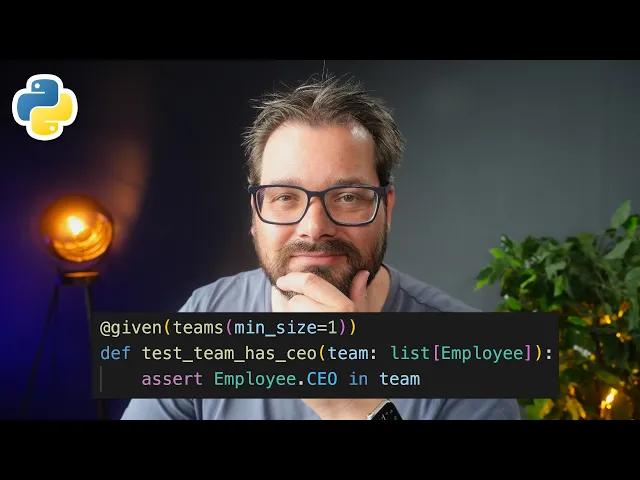
Coverage and mutation guardrails#
Passing tests mean little if they never execute the risky code paths. Couple coverage metrics with mutation testing to be sure the suite bites back.
- Measure the baseline:
uv run coverage run -m pytest && uv run coverage report -mverifies new AI patches widen coverage rather than shrinking it. Coverage.py surfaces untouched branches. - Mutate to validate: mutmut flips operators and literals. Surviving mutants expose brittle or missing assertions.
uv run mutmut run --paths-to-mutate package/ --tests-dir tests/
uv run mutmut results- Script nightly guardrails: Run mutation testing asynchronously (nightly or on beefy agents) and file issues for mutants that survive multiple spins.
Hidden adversarial checks#
Agent-generated code tends to overfit visible tests. Keep a small stash of unseen cases that run in CI but stay out of the prompt history.
- Hide tricky fixtures: Store adversarial fixtures (rounded floats, locale surprises, sample vs population stats) under
tests/hidden/and skip them locally with an env flag. - Property + example pairing: Combine Hypothesis strategies with hand-crafted edge fixtures using
@pytest.mark.parametrizeto guarantee known-bad paths stay covered. - Test data packs: Maintain tiny, versioned fixture bundles for critical domains (currencies, encodings, timezone transitions). Publish them as
tests/fixtures/<feature>so agents can read structure but not exact values.
End-to-end smoke bots#
Keep at least one high-value flow green to catch integration bugs even when unit tests pass.
Script minimal Playwright runs: Use Playwright for Python or platform agents to drive the UI the AI just modified.
Sandbox for determinism: Launch against seeded datasets or mock services so AI patches do not flake the smoke tests.
Automate from the CLI:
uv run playwright install chromium uv run playwright test tests/e2e/smoke.spec.ts --headed=false --repeat-each=2Agent-in-the-loop: Some coders run Playwright via MCP or Codex sandbox tasks so the AI can verify its own output. Require human review of logs before merge.
LLM-assisted grading (with guardrails)#
Treat LLM judges as advisory signals layered on top of runnable tests.
- Prompt from diffs: Provide the patch, the failing test names, and the domain rubric. Ask for a risk score, not approval.
- Never skip executables: Only auto-merge if both runnable tests and LLM checks agree.
- Log everything: Archive judge prompts/responses for audit; rotate prompts to reduce prompt overfitting.
Operational checklist#
- Start every new AI ticket by drafting a failing unit/property test (premortem).
- Keep scorecards fast enough to run on every agent iteration (<1 minute ideal).
- Enrich suites weekly with at least one new hidden/adversarial case per bug found.
- Track coverage deltas and mutation survivors; fix the tests, not the tool.
- Document how to run smoke bots locally so humans can verify before merge.